Please enjoy these sample chapters from THE VANDEMONIAN, regards Allan
Chapter 13: Robots
Becoming a roboticist was inevitable for me.
Mechanics were all around me growing up. Uncle Cedric was a farmer from a farming family, but his passion was mechanisms and his farm shed was a massive workshop with every machine shop tool imaginable. In later life Uncle Cedric ran automobile garages and I used them to work on my first cars. I used his tools for other things. In my early electronics days, when still a teenager, I made radios, all with vacuum tubes, or valves as we called them, which required round holes to be cut through the metal chassis to mount the Bakelite valve sockets in the base, and it was Uncle Cedric’s metal hole cutters that I used. I remember him keenly observing me making a radio, something outside of his experience, fascinated, as my dad was when I made the dinghy.
Uncle Lionel Hart was a rigger and a welder of heavy equipment and also a talented mechanic, but more remarkably he was a fearless daredevil like Evel Knievel. He rode motorbikes in the Globe of Death at fairgrounds.
Uncle David Branch was like Cedric, a homemade mechanic who could repair anything, fabricate anything, solve any mechanical challenge. They all lived in oil and grease. All of them competed in racing cars at times.
Dad was a carpenter, a different breed. He was a competent mechanic as well, but more at home with a saw than a spanner. Many of Dad’s other friends, like petite Jimmy Brown, mostly bred and trained and raced horses, and some of them were different types of riggers, ‘rigging’ the races, giving us furtive tips like ‘Number 7 in race 5’. They rarely bared fruit.
Sometimes the mechanical and woodworking skills of Uncle Cedric and Dad, who were the closest of friends, combined. In the mid-1950s Dad came home with a new car; in fact, the first car I remember us having, a Standard Vanguard, manufactured by the same company that made Ferguson tractors, powered by a bulky 4-cylinder tractor engine. It could not have been Dad’s first vehicle, because we arrived at South Arm with the chooks in a lorry that I presume was his, but our first family car. South Arm was a fertile peninsula of land jutting into the massive Derwent River where Uncle Cedric, part of the landed gentry, had a large potato farm and Dad worked with him. Our Vanguard was a ute, short Aussie term for utility, suitable for a farm, the Australian version of a pick-up truck but more comfortable. It had a sedan front with an integrated utility tray with panelling along the sides to the rear and a tailgate. The closest in the USA is an El Camino. Dad needed a canopy to cover the tray, so they decide to make it themselves in Cedric’s fully stocked workshop at South Arm. To mould the plywood to a curved U-shape, they first steamed the wood under hessian matting made from sacks until it was soft and pliable from steam drawn through hoses from a furnace boiling water, then rolled it to a metal frame to get the desired shape. I have always had a favourite memory of that project in progress at Uncle Cedric’s spacious workshop: plywood flat along the floor and steaming as if capping a hot spring. Not old enough then to be aware of the inventiveness and ingenuity of that day. I remember also axles and pulleys and belts running along the rear of the workshop, rotating all the heavy-duty equipment like lathes, drills, saws and mills, compressors and boilers, from a single power source. Years later I saw the same type of old-style machine shop in Solingen in Germany where they made knives and scissors. A pre-war factory preserved as a museum. I wish my Uncle Cedric’s workshop was still there, preserved as a museum. I wish my uncles and Dad were still here.
As the number of kids in our family expanded, we would sit protected from the elements in the back of the Vanguard under this canopy on blankets and pillows as we all rolled off to Waddamana for weekends and holidays of adventure.
Every Christmas and birthday, my gifts included Meccano sets; Erector sets in the USA. I loved them. I quickly outgrew constructing cranes and trains from instructions in the kit, and began making my own designs. I recall a vehicle, car or truck I do not remember, maybe a ute, and it having steering, which was not unusual, but I gave it a steering mechanism like a car’s rack and pinion. A miniature steering wheel actually turned the front wheels. I almost definitely had help from one of the uncles, as the extended family usually ended up at Nan’s place at Waddamana for Christmas, but I think of it as something I did. My mechanical interest progressed to gramophones, those wind-up, spring-driven mechanical devices with large sound horns and stainless-steel needles on a fast spinning 78 RPM shellac disc, preceding electronic record players. Scratchy sounds. Uncle Lionel and Dad removed the coil spring whenever I overwound it breaking the end, using the flame from the gas stovetop in the kitchen and tools to shape a new end so it could be used again. A miniature blacksmith’s furnace and anvil. I watched and learned and participated.
As I grew up, I could repair an engine or mechanical device like a kitchen appliance, so my mechanical skills were therefore not bad, but nothing like my uncles’. My ability proved to be suited to more creative endeavours. At one stage I lived in Ponsonby, in the suburbs of Auckland, New Zealand, and was working with Bob Duncan at his electronics repair shop, Bear Electronics, in Ellerslie. I’d use the fantastically named Kyber Pass Road and Lady’s Mile to get to work. I’d bought a cheap, used Austin 1800, dirty brown colour, that burned more oil than petrol. When repair jobs were slow, we’d select something from the back room which held a collection of rejected repairs, those too expensive or too difficult to repair, and try again to fix them to resell for extra cash. It became a competition as we all diagnosed and repaired the radios, televisions and record players, trying to outdo each other. Eventually there was only an automatic record player left, the type where a dozen or so records are place on a spindle and played automatically one after the other. I asked Bob about its history. He said everyone had had a go at it, but it could not be fixed. I said, ‘I can do that.’ It turned out that the complex player mechanism had been pulled apart, and what I started with was a box of strangely shaped pieces, like Meccano, which I managed readily enough to reassemble. That was already impressive enough to my intrigued observers, but it was not functional even though everything was in place. The comments were that I had reassembled the parts incorrectly, but it was clear to me that there was a missing piece. We searched through the storeroom but there were no more pieces. No one had recognised that problem, which is why it would never play. Using my imagination, I worked out what the missing piece should look like, what function it would have had, then fabricated one from a bit of plate metal, a strange three-sided lever arrangement, and made the player work. This visualisation of problems and solutions, in a mechanical sense, is a key to how my brain works, I think.
A similar story is from many years later when at Jon Jarvik’s in Pittsburgh I was boasting about these skills and he said he had just such a player in the attic that also did not work. Records always got stuck and never dropped. Did I want to fix that? In fact, he was calling my bluff. Of course: ‘I can do that.’ The central spindle in these machines had a slider in a slot in the shaft that looked a bit like a nail file. It had an edge sticking out proud that held the records up, and at the end of playing a record, the slider inserted itself flush into the slot in the shaft to let the next record fall down under gravity. The slider had become bent and the friction rubbing against the sides of the slot was enough to prevent it going all the way into the slot. The next record would never fall down, and the same record on the platter played over and over. It was the difference between knowing the basics of machines – wheels, levers, pulleys, screws – versus the real world of materials: friction, heat, gravity, expansion. Jon was, and is, impressed, especially after I demonstrated invisible mending on two of his jackets that had holes in them. I used to darn my own socks too, but now in this throwaway society you can buy a six-pack of tube socks off a cart on a dusty New York street for less than a spool of cotton.
The turning point for me was reading a series of articles called Bionics in a British hobby magazine. It may have been called Practical Electronics. I was maybe 17. The articles were instructions for making electronic robotic mice, similar to William Grey Walter’s tortoises. One of the last issues in the Bionics series demonstrated self-recognition, through simple light and photo sensor circuits, a sort of primitive insect vision. Two of the robots would react if they saw each other. It fascinated me. I felt that I could make a better system, which gave me an interest in vision systems, which led later to my submission on vision in the students science talent quest. The submission, ‘A Trichotomy on Vision’, introduced pattern recognition using neural nets. I know now that it was the germination of my transition from an interest in physical sciences to biological sciences as I studied and learned about vision systems in all manner of organisms. It also led to my side work to test the idea with Dr Ian Newton at the University of Tasmania when I was a student at medical school and he was my Medical Biophysics lecturer. By then I had developed the early pattern recognition concepts from the Trichotomy on Vision to a full-blown AI system to recognise hand-drawn patterns. Before personal computers, after hours we commandeered and programmed the university’s mainframe computer to run simulation programs, to assess the theoretical pattern recognition’s ability to recognise handwritten characters. The computer normally took care of student files and courses.
In the history of automata pre-1948 and especially during the 1800s, there were examples of earlier automaton mechanisms – fascinating and ingenious clockwork things writing letters, drawing pictures or playing music usually. Impressive but limited. In my view, Grey Walter was easily the world’s first roboticist. Grey Walter created robotic machines that were dubbed tortoises. They displayed phototaxis, an attraction to light. When they saw a light, they homed in on it, leading to a hutch to recharge their batteries, years ahead of the Johns Hopkins Beast. He is important to me for his robotics, but he was a pioneer in much more, including, amazingly, his early work on imaging tomography, the technology behind CAT scans, which have revolutionised medicine.
Then, while still at university, something tragic occurred. A close friend of mine who was also a student in Dr Newman’s classes went home to Malaysia for the Christmas break and returned with a leg amputated because of a motorbike accident. He approached me and asked if I could devise an artificial leg for him, something better than the prosthetics available. I regret that, although I did later make an artificial hand and take out a provisional patent for controlling it by brain thought waves, I never made an artificial leg for him. I met up with him much later in Malaysia, and he was happy and content with a family and a successful engineering career, running around on the much-improved legs then available. What it did for me was turn my attention to more than just pattern recognition and artificial vision. So, it was no wonder that just a few years later I said, ‘I can do that,’ when Sandra Wills came to me from Elizabeth College asking if I could build a robot turtle.
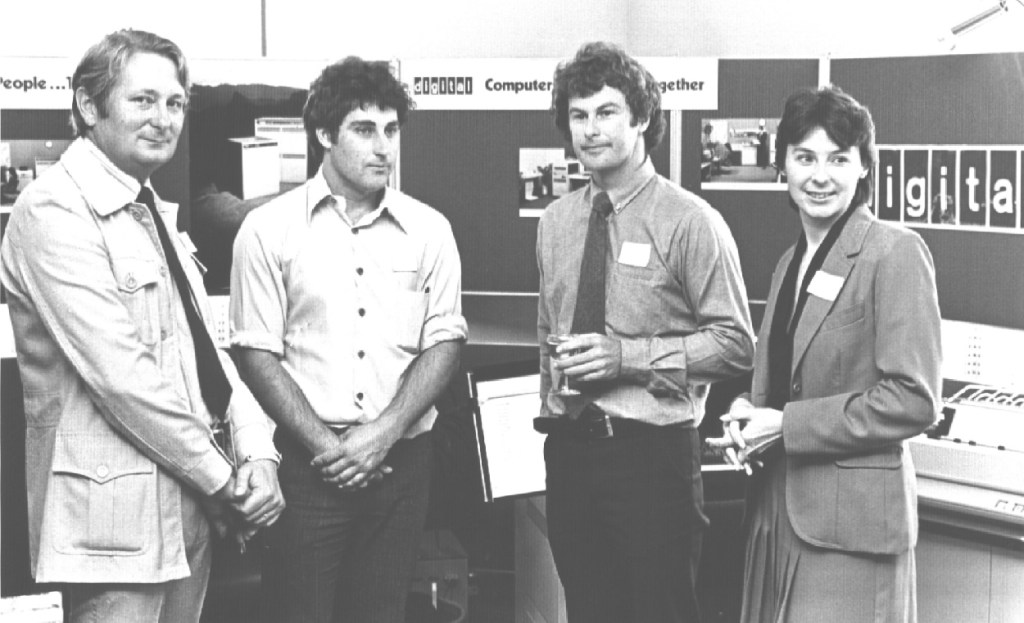
Actually, my first attempt at a whole physical robot was a little before that. I had been repairing jukeboxes at the Automatic Music Company in Hobart. I removed a flat wooden box that served as a woofer horn from the top of an ancient jukebox to use as the base of a robot. My schoolmate David Briers the school’s most athletic performer, who taught me to wrestle and to jump fearlessly off high house rooftops, who became a fitter and turner, made the mechanical propulsion pieces for me. Apart from running around with a battery and some motors, though, it never progressed. Too heavy and bulky and impractical. My idea of what constituted a robot was naïve back then, but it taught me what not to do for what became the Tasman Turtle design.
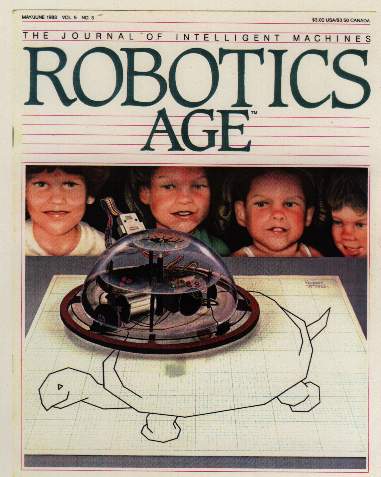
Originally conceived of for teaching educational classes using the computer language Logo, the Tasman Turtle, when it was completed and commercialised, served to fill an unexpected niche for much more than what it was designed for. It quickly came to serve as a model for sophisticated hobby and large toy robots like Elami and Omnibot for companies like Keystone and Tomy, but more importantly it opened up doors with the likes of Radio Shack and Commodore and General Electric and, in turn, networking opportunities with names like Nolan Bushnell, Jack Tramiel, Bernie Appel, Rodney Brooks, Hans Moravec, Isaac Asimov, and the Father of Robotics, Joe Engelberger, who co-invented and developed the robot arm with George Devol, forming the first robotics company Unimation. There was clearly a need for a useful, practical robot chassis that could serve as the basis of anything an aspiring roboticist wanted. My company and my product and my name became solidified in the international robotics sector.
And so it begins. I relish the spotlight. I discover there was no other enterprise like mine, anywhere. My company, starting as Aero Electronics, then Branch and Associated, then Flexible Systems and finally Denning Branch International, becomes the prototype robotics company for the commercial side of the industry, the Tasman Turtle the prototype general purpose robot. I become the industry’s prototype spokesperson. I’m away.
Those external projects with such important names and companies required me, as the inventor and proponent of my company’s technology, to lead their projects hands-on, either completing them if they had stalled, or starting them if they were just dreams. So, this was the beginning of a globe-trotting career, transferring my technology and skills, under licence or paid, to exciting companies in exciting places with exciting people. This was a fast-paced time, quick contracts, rapid engagements, loose arrangements because of the vague project definitions and need for an indefinable solution, a period for me that could be interpreted as outsourcing, or equally as an inhouse consultant under secondment.
For 20 years I was part of that scene, but in a funny way I was the odd man out. Apart from a couple of later companies like Cybermotion, the robotics activity in those early years was mainly centred on academic research with fantastic but one-off research vehicles like Han’s Pluto. Those robots had no commercial aspirations. Instead I was out there making and selling toy, hobby, educational, industrial, research and domestic robots. Devices that performed a function that people were willing to pay money for. It was more about marketing than technology.
Unlike in Australia where there is little scientific research inside companies, the preference being for universities, I had moved into that uniquely American rarefied zone of commerce driven by internal corporate R&D and IP. I was not running a university research lab, I was running my private lab with a bunch of PhDs working with me. That close association with scientists meant there was always a vestigial longing within me to be part of academia. I was making scientific discoveries that were trade secrets that I could not publish or divulge.
This networking sometimes led to other problems. John Holland at Cybermotion had become a friend. We had stayed at each other’s residences when we visited each other, me in New York, John in Roanoke, Virginia. When I took over Denning, it turned out that Denning had used a three-wheeled omnidirectional motion system similar to John’s robot Kludge. It was nothing to do with me, but he interpreted my involvement with Denning as dishonour and our friendship ended.
Until I returned to Hobart from Texas to develop Blinker, apart from some simplistic navigation and mapping through touch and feel, by bumping into a wall or object and sensing it with a touch sensor, or using sonar to detect objects nearby, all of my robots navigated in an unreliable and inaccurate mode called dead reckoning. Basically, dead reckoning is blindly counting an estimate of how far had been travelled and in what direction from wheel encoders or by measuring how much time had transpired. A guessing game. It’s exactly like those early sailors and explorers trying to estimate longitude before John Harrison’s amazing clock allowed them to compute it from time differences. Harrison, a self-made inventor, had to fight the academic establishment to be recognised for his achievements. Shaft encoders to count wheel rotations increase accuracy but errors can occur because of slipping and friction. True autonomous navigation, necessary for effective performance of any useful task by a robot, requires a map and an ability to know at any time where the robot is within the map. Maps can be entered in advance, like a floor plan, but more useful and more complex are technologies where a robot operates in an unknown and unstructured environment, building the map itself, through vision, sonar, radar or other sensors more advanced than bumpers or wheel encoders.
Creating such a technology became my obsession.
Taking this to a more pragmatic level is an even greater challenge when the operator of the robot is a non-technical person who cannot enter a programmed map, or do anything other than turn it on or off, to operate the robot in its environment. A quintessential example of that is floor cleaning. Few people vacuuming a floor know or care about motors and fans and vacuums and filters. A vacuum cleaner robot is a vacuum cleaner. An appliance. The average person using a robot vacuum cleaner would know nothing of robotics. This led to my interest in the ergonomics of design, the skill to create complex and advanced automation systems at a low price and with good human machine interfaces. These were huge steps for someone starting off as a run-of-the-mill techno-nerd. It is probably lack of attention to these things that prevented, still prevent, many promising inventors from commercial success.
Outside of the markets I already dominated – education, hobby, research – it was a struggle to find new near-term markets. There were a few smallish ones, like disaster robots and bomb disposal robots, but others required the science fiction of humanoids. One potential market was the one just mentioned, domestic cleaning. I always believed that there would be a market for a robot vacuum cleaner, but one of the tenets that I established of turning around companies was to conduct independent market research, in case you are fooling yourself. I contracted well-known Australian research firm Roy Morgan, which discovered in a national survey that there was indeed a huge multibillion dollar market for such an appliance. That was not enough, though; I needed to verify it with a duplicate survey. I hired my sister Olannah, and we conducted our own in-house phone market research using the same Roy Morgan survey questions, statewide, which on extrapolation generated the same results. The exercise taught us how to do such unbiased market research for other products. In 1987 the initial global market size for a practical domestic robot vacuum cleaner was 12 billion dollars.
The survey research not only uncovered the massive size of the robotic domestic vacuum cleaning market but exposed some key product specifications about retail price and product functionality that were necessary if the market potential was to be reached. If these were not met, the product sales deteriorated dramatically. From this invaluable pricing information, I discovered the wonderfully useful Optimum Pricing Curve, and calculated the best price to make the most profit from sales of such a device. That was another revelation: that it was possible to determine without trial and error the introductory price of a new category of product. It was a bit like my amazement in early high school lessons, learning about Newton’s mechanics, and discovering that it is possible to predict the result of momentum and forces, like where a missile will land.
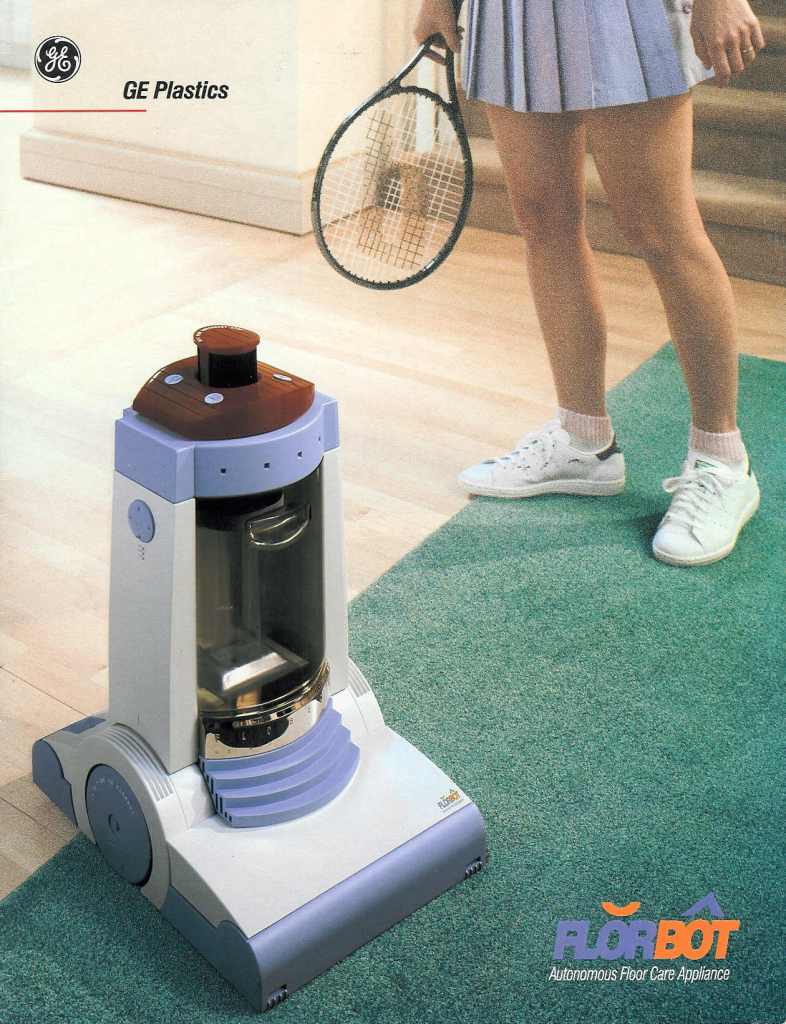
The first project to create a robot vacuum cleaner came to me out of the blue; the Florbot robot for General Electric Plastics (more about that in Chapter 13). GEP did not manufacture vacuum cleaners, of course, but they supplied most of the plastic to those manufacturers who did make them. The industry was flat, no growth, because as a mature industry, there was no innovation. All industry sales were essentially what are called maintenance sales; a customer buys a new one when their old one wears out or breaks down. Marketers get over this problem by making new designs, making the old ones obsolete. We see it with cars all the time. A perfectly good car starts to look dated, and psychologically we are teased into updating it. GEP decided to stimulate plastic sales by doing the innovation work for their customers. They saw a robot as a new category of product that could boost their plastics sales.
The second opportunity came to me unsolicited, too, from Moulinex in France. Like many of the robotic projects that came to us from companies noticing the Tasman Turtle, Moulinex had started a robot vacuum cleaner project, which proved what everyone else had discovered: that it was unexpectedly difficult. There were few options for them to reach out to for assistance, so, of course, they discovered me. We built d’Entrecasteaux for them.
Following those projects, travelling the world, I presented the opportunity to all the major global players in the vacuum cleaner market, together with the market research. Several of them took up the project, but without me. When I disclose sensitive inside information I reserve something for my own security. That was the approach that worked with GE Plastics. For the vacuum cleaner companies I disclosed the market research, but not the functionality or pricing research. All of them applied misguided pricing strategies, ignoring independent market research available from me; these companies set their own pricing, typically exorbitantly high, resulting notably in one case, in zero sales. Mistakenly, those companies believed that the demand for such an amazing appliance that cleaned the floor autonomously must demand a high price. They ignored the ‘elastic market’ rule that caps the price for certain product categories. They knew marketing 101 but not marketing 202.
I was visiting Rodney Brooks at MIT in the mid-1990s, maybe 1997, and showed him some video of our autonomous robot navigation projects. He clearly had never been aware of our work and he was beside himself with excitement. Rodney, an Australian, at that time head of the robotics activities at MIT (who together with Hans Moravec who was at CMU) was one of the most preeminent robot researchers anywhere. These were the scientists carrying on from the work of William Grey Walter. Having such a reaction from Rodney was alarming, unexpected. He grabbed me in his fervour and said, ‘Come with me.’ We walked from Cambridge down a few blocks to his private company iRobot, run by his cofounders Colin Angle and Helen Greiner.
Back then they were a tiny backwater robotics company with a handful of employees, surviving off small federal government and defence research contracts, but clearly in a strong market position because of the MIT connection. Like all of my competitors I was very much informed about them and had briefly met Colin and Helen on a previous occasion. Once we were in their office Rodney disappeared with my videos to meet with Colin and Helen, then came back saying he wanted me to join iRobot with them and had spoken to his cofounders. They had stayed in their offices and I did not see them. My memory is that Colin was in agreement, but Helen could not be convinced. Without a consensus it did not happen. iRobot subsequently released their Roomba robot floor vacuum cleaner. They stuck to the pricing rules determined by the Roy Morgan research. Such a price limit proved difficult for even iRobot to install full functionality to their robot, so the first one was a device with much lesser performance than we had in our prototypes, but with their name and having raised funding through an IPO, they have subsequently sold and are selling billions of dollars worth of robot vacuum cleaners, as my market research predicted.
At this time I was very interested in why there was such a tight price constraint on such a complex and useful advanced technology. I considered other technologies such as medical breakthroughs. If a cure for cancer were to be discovered, the inventor could demand whatever price they wanted, and the demand would be there. If there was a discovery of a manyfold increase in telecommunications bandwidth, the price would not be an issue because of the demand. Why, with a smart, autonomous robot, did the same rule not apply? It turns out that in the case of those other examples, there is no alternative, no competitor, whereas with robots there is a powerful alternative, a competitor. The competitor is the human that the robot is attempting to replace. A human doing vacuum cleaning, for instance, is an unskilled worker with a set maximum hourly wage, which is low. Even an unskilled worker, though, is a very effective cleaner, far superior to any robot vacuum cleaner, so the performance of the competitor is very high. Unless a robot vacuum cleaner is as cheap as human labour and can clean as effectively, then there is limited market demand and the customer will hire a human cleaner instead of buying a robot. That was why the other companies that had good machines, better than Roomba, but prices ten times higher, could not sell them. A human can prepare the room for the vacuum cleaner, move furniture around, does not get stuck in corners, can see what still needs extra cleaning, and do all those ancillary tasks critical to vacuum cleaning. Once a robot achieves such functionality the market size will be incalculable.
When there is a competitor like that, the product has to be differentiated. Pricing is one differentiator, but there are better ones. Robots do not steal, sleep on the job, demand additional wages, can work day or night even with the lights off. So, once the price and functionality has been matched, the robot has other benefits.
I wrote all of this up in a paper called ‘The 15 Year Cycle of Robotics’, published it, then presented it at lectures, seminars and conferences. I was accountable for about 60 per cent of the global robotics industry at that time; however, in 1997 I subsequently exited the industry I had pioneered in 1979, forever. It was one of the hardest decisions in my life, but I’d had to admit to myself that there was no market for robots. Yes, they were always topical, of course, and always exciting, there’s always research being done on them and they’re always in movies and novels, but decades later, apart from the Roombas wandering around or shelved in closets, no one owns a robot.
The next stage in my life, my Middle Ages, was like driving down a rutted road, the car going where the ruts take it, not where one plans to go.
Chapter 16: Kanna Leena
In 1876 the world’s first hydroelectric turbine was established in England by William Armstrong to light his house at Cragside in Northumberland. Not as trivial as it sounds, Cragside being the size of a small village. It was only 40 years from the actual invention of the generator by Michael Faraday, a primitive device and really only a demonstration of the induction principle – how a magnetic field from a wire with electricity here will induce an electric current in a close by wire there. Just another 40 years later, the Tasmanian state government’s hydroelectric power station was operating at Waddamana, a village hidden in a deep valley among craggy mountains and silver lakes in the literal geographical centre of the state. Visionary is the only way to describe the plans and aspirations of the team that built such a revolutionary, pun intended, infrastructure. To me it is akin to the dream in 1962 of putting a man on the moon by 1970. Daring, idealistic, risky.
The hum of massive vertical Pelton wheels spinning 50 times a second day and night from anywhere in the Waddamana village are among my earliest auditory memories. That and standing on the green metal viewing gantry high on the main wall of the incongruous art deco power station building, looking down on the rows of energetic turbines like terracotta sentries, or as cousin Greg suggested, terracotta snails, the noise preventing any conversation.
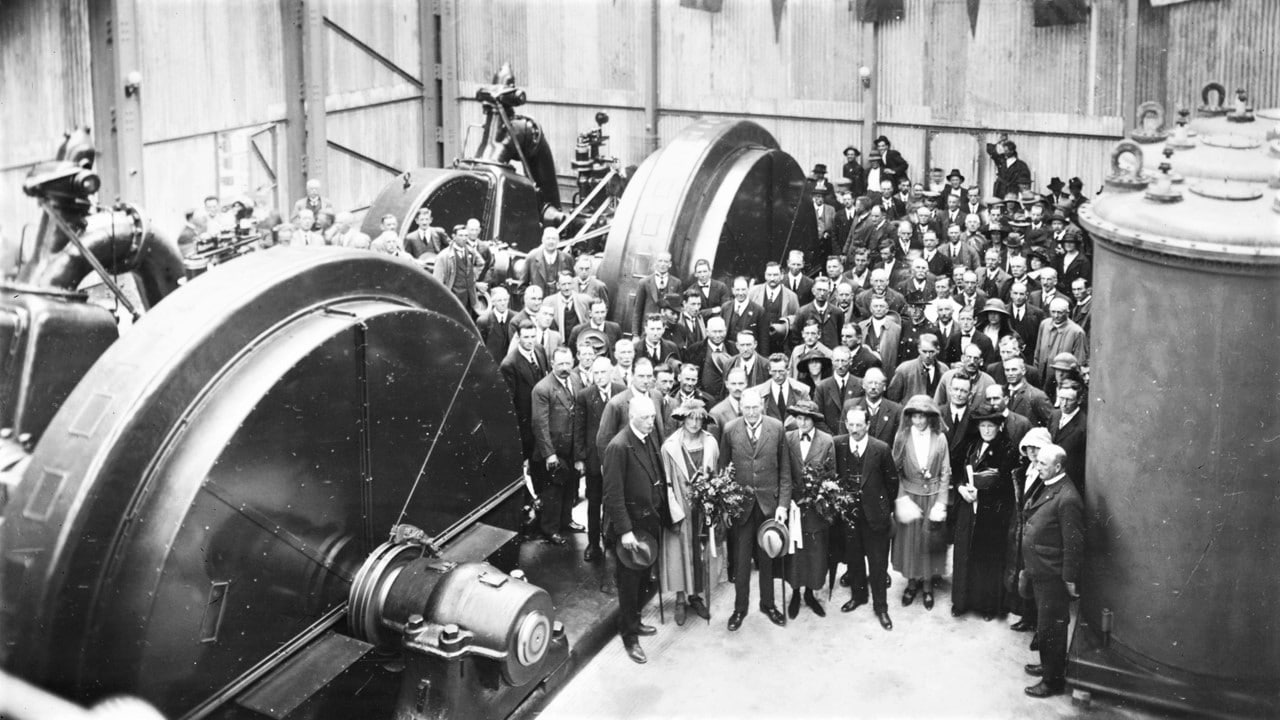
Waddamana was not the first electrical generator in the state. Amazingly, the first was in 1895, less than a decade after Cragside. That is almost impossible to put into perspective for a tiny state with a tiny population at the tail end of the world; this kind of accomplishment was more expected in the laboratories of someone like Edison in New Jersey. But there it is, Duck Reach Power Station, the first hydroelectric generator in the Southern Hemisphere, powering the arc lamps of the sleepy hollow called Launceston, the work of the Launceston city civil engineer with the unlikely name of Charles St John David. But it was, like they say, in the air; there were other small private generators; one in Queenstown, for instance, when this now almost abandoned centre for Mt Lyell copper mines was once one of the state’s largest towns. Mining generates money, generates commerce, generates invention. Australia’s first stock exchange, for instance, was in the remote Queensland mining town of Charters Towers. In Tasmania, it seems, mining generated generators.
Charles Wesley was my science teacher and home class master for my first year at high school. He was very English, from England, and I remember learning about soft and hard water, despite Tasmania having no hard water, not understanding the relevance. And I remember his chemistry lessons, enthralling little bombs and explosions and smoke and smells. I learned that metals like zinc and aluminium required lots of electricity to electrolyse the ore and extract the minerals. Wesley was gruff, a prototype for Trevor Howard’s Captain Bligh and just as intimidating. So competent and knowledgeable about things that, like Bligh, he surely would have been able to navigate a dingy to shore from anywhere in the ocean. One evening’s excursion was to the school yards to identify all the stars, as if each were his favourite pupils, and I can still dole out the members of upside-down Orion, hunting on his head, and remember that there are seven sisters in Pleiades. I’m a Gemini and I learned to recognise Castor and Pollux. Like Bligh, Wesley would have navigated by the stars. I never had a better teacher. He secretly gave me lab glassware and chemicals to encourage my experimenting hobby at home, to supplement the chemistry set I received one birthday, which was ultimately used to etch the chromium off our kitchen sink with acids. The damage was so complete, so final, it was one of the few times I remember Dad looking in disbelief, too dumbfounded to give me the beating I deserved.
As is often the case, the true visionary behind Waddamana was not the government. In this case it was an intense and bespectacled metallurgist and inventor from NSW, James Hyndes Gillies, who came prospecting for locations to build an electricity generator in Tasmania in 1906. It was an earth-moving infrastructure undertaking of a style and scale more reminiscent of Isambard Kingdom Brunel or John August Roebling and their awe-inspiring bridges and tunnels. Seems that three propitious names are a prerequisite for being a prominent civil engineering entrepreneur. Gillies had invented and patented processing techniques for calcium carbide and zinc, both requiring lots of electricity, which was his driving motivation. The project was massive enough to require government approval and new legislation.
Regardless of his success at raising investment funds on trips back to London and acquiring the engineering materials from America, like my dad, a businessman he was not. Although it is debatable whether the political forces were deliberately set against him once the Tasmanian state government saw a cheap fire-sale opportunity for his patently brilliant plan. So, also like my dad, he ended up fighting the system, which in his case was the possibly unethical Tasmanian government, and losing. The double-dealing Labour government of the time was busy compiling a secret viability report on the project, clearly coveting it, at the same time as they were refusing Gillies additional time. Their very public investigation, probably with a duplicitous agendum, would not have helped either. Perhaps not so much business sense, as Gillies very adequately raised funds, gathered a talented team, and made considerable early progress on such a complex endeavour in such an inhospitable part of the planet, but more likely his not understanding the self-serving structure of political society. My dad hit his head against the brick wall of the same society and the machinations of politicians all his life. Machinations documented in Sun Tzu’s Art of War, perfected by Niccolo Machiavelli in The Prince, and weapon of choice of Labour governments worldwide. It was another 20 years before the Tasmanian government saw fit to reward a much-deserved pension lifeline for the then destitute Gillies.
One never wins against such a force. Inevitably, the Hydro-Electric Power and Metallurgical Co. Ltd. was listed on the London stock exchange, and a division of Gillies’ holding company, Complex Ores, became fatally financially stressed. A record cold snap in 1912 did not help in this terrain and weather, which is difficult at the best of times. The government’s newly created Hydro Electric Department acquired his works in 1914 and the finished power station, later known as Waddamana A, was operational from 1916. It is indicative of how far Gillies had come in his eight years that the government capital could complete his work in two years and be operational, earning revenues. In my marketing workshops I often say, ‘Everyone is lining up to be second.’ It is a lesson about those sitting patiently on the side, watching and waiting for good work to collapse under lack of resources, to vulture the scraps despite having invested little themselves.
In my mind, Gillies deserves to be remembered more than he is, as the ‘Father of the Tasmanian Hydro’. The project was ingeniously simple. Tasmania’s largest lake, called, wait for it, Great Lake, emptied into the Shannon River high above the tree line on the plateau called The Steppes. The Shannon trickled a long way, eventually into the River Derwent, which is a deep, wide fjord bisecting the capital city of Hobart where I would also end up. A short way away from the Shannon River, at a much lower elevation in a very steep valley, was the Ouse River. A shortcut canal cut across The Steppes could conveniently divert the waters of the Shannon to precipitously fall to the Ouse. Falling water has energy, potential energy, potential to drive something like a water wheel or dynamo.
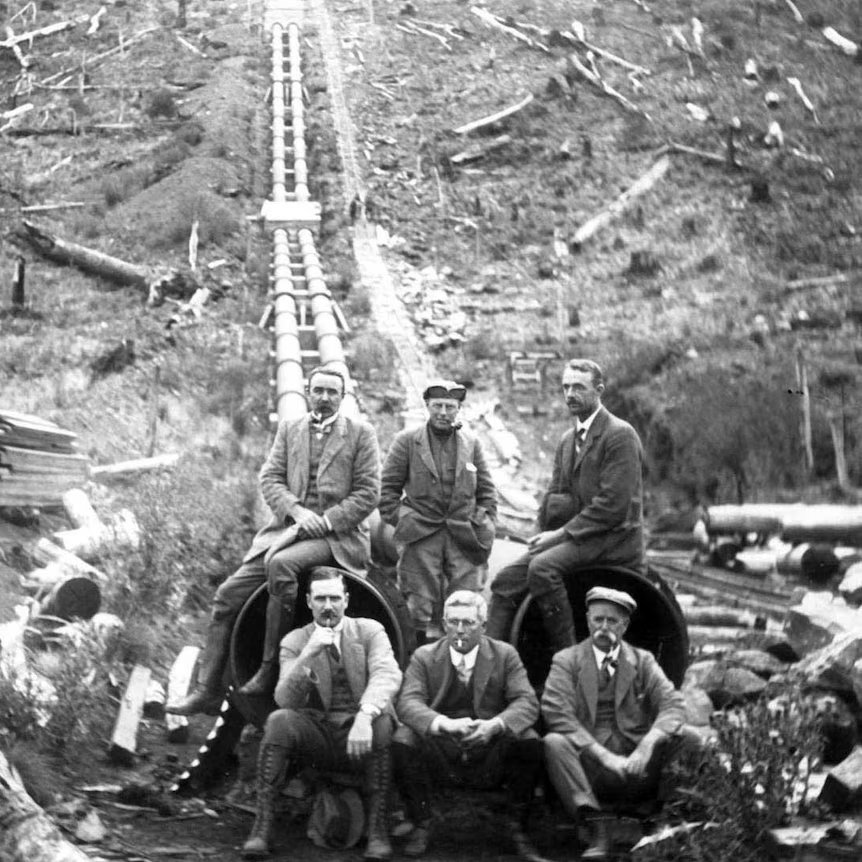
But someone has to do the work to transform vision to reality. Along comes Alexander McAulay, professor of mathematics and physics at the University of Tasmania, with his ability to determine how much water flows out of Great Lake along the Shannon River, and how much would be needed to turn turbines in the valley of the Ouse River, which also flows to the River Derwent, whose water in turn flows out of the massive estuary to the Great Southern Ocean, destined to circle Antarctica, so all was okay. A small masonry dam at Great Lake to increase and control capacity was the gambit; then a canal to a penstock holding pond, a downhill pipeline, then a bunch of turbines feeding power lines on pylons to Hobart. Most of it across Crown Land, so no private property to purchase and compensate, along trails cleared by my Uncle David Branch. A small village of workers near the power station pops up and is called Waddamana, ‘running water’.
McAuley loved the area. Rugged, isolated, and conveniently near his friends at the Wihareja property just off the unsealed country road to the lakes. Amidst the works, alongside the Shannon River and canal, he built a rustic but comfortable country lodge called Kanna Leena. This became the engineering and academic headquarters for the project, with all manner of interested political, industrial, financial and engineering parties visiting all the time including the particularly savvy John Butters, who managed to stay as the project’s chief engineer under each of the project’s ownerships as they changed. McAuley’s son, also a professor at the university, and his fiancée were also visitors. But with rugged wilderness and complex terraforming comes risk and danger.

Interest in the property waned after the tragedy of the drowning of Margaret Kathleen Hogarth, the bride of McAuley’s son Alexander Leicester McAuley Jr, on their honeymoon on 9 January 1931, while bathing in the Shannon River at Kanna Leena. By the 1950s, Kanna Leena was deserted. You wouldn’t read about such a misfortune except in an autobiography.
When my newlywed father needed a place to live with his wife and a baby boy, we moved there, a couple of miles from his single men’s quarters on the other side of the Penstock Lagoon. I was the baby, and this was my first home. The house burned down some time ago, but before it did, I visited there several times. The first time was with my dad, who showed me the primitive living conditions – no electricity, of course, or internal plumbing – the nursery in the tiny room at the rear of the house where my cot was located, and the by then miniscule Shannon River to the side of the property. With the power stations decommissioned, and the massive pipelines removed, there was no longer a need for diverting water.
My dad was an apprenticed carpenter with the Hydro Electric Commission, living initially at a desolate temporary construction camp called Hill Top, adjacent to the high Penstock Lagoon, and part of the team that constructed the wooden stave pipelines down to Waddamana B station. The camp was for single men, no more than boys some of them. The remnants are still there if you wander off the road and search amongst the brush. You’ll find some foundations and prominent concrete steps leading nowhere – appropriate for this area known as The Steppes. Married men usually had a house in Waddamana village, at the bottom of the valley. When I was conceived and he married my mother, in that order, just in time, he had to find married men’s accommodation, none of which was available in the village. By then, though, Kanna Leena was abandoned, and it was offered to him. So, my first home was Professor Andrew McAuley’s country chalet, which had also been the first headquarters of the nascent hydroelectric scheme and the site of a horrifying drowning, on the trail of the canal from Great Lake to the Waddamana penstock.
These were academic giants, these people before me, but there were giants in my early life too. One of my first jobs was as a junior technician with the Department of Surgery at the University of Tasmania, operating along with Professor Robert Mitchell pioneering kidney transplants, and where I learned that the same Alexander Leicester McAuley Jr, when a professor at the University of Tasmania, was instrumental in the creation of an optics facility to supply precision sights and lenses during World War II, pioneering revolutionary optical design science. And I knew of Grote Reber, a USA scientist but also a researcher at the University of Tasmania, pioneer of radio astronomy, because I recalled his acres of arrays of poles and wire antennae at Llanherne adjacent to the Hobart Airport, and because he retired to Bothwell, last stop before Waddamana, where he was a local, albeit eccentric, celebrity, having a beer with my brother at the Castle Hotel. Or Dr June Olley, food scientist at the University but previously with the Australian national science body CSIRO, and with whom I published an academic paper on measuring the quality of fish. Today the University, like many others in Australia, seems to me to focus on enrolment fees from overseas students and little else.
There have been and are many Vandemonians. Most famous was probably Errol Flynn, born in Hobart to a biology professor at the University of Tasmania, to become the most prominent swashbuckling Hollywood actor of his era. Then there was Christopher Koch, who wrote the novel The Year of Living Dangerously, with its film adaptation starring Mel Gibson and Sigourney Weaver; Nan Chauncy, writing about children adventures; and Richard Flanagan, the Man Booker prize-winning author. Who else? Joseph Lyons, the only Tasmanian Prime Minister of Australia. Mary Donaldson, now Queen of Denmark. Bob Brown, founder of the world’s first Green Party. Cricketers Ricky Ponting and David Boon, world champion swimmer Ariarne Titmus. Media celebrity Charles Woolley. Martyn Bryant, Australia’s worst mass murderer. Truganini was the last full-blooded Tasmanian Aborigine, and perhaps the only true Vandemonian in this list.

